Software development after coding: Are we thinking too conservatively?


For the past few months, I've been thinking about how AI is changing software development. I don't think the biggest change is that AI can write code. The much bigger question is:
Are we massively underestimating how software engineering itself will change over the next 5–10 years?
Most discussions today focus on AI-assisted coding, agentic coding, or autonomous software factories. But these may only be the first step.
We might be discussing the wrong problem
The usual questions are:
- Will AI replace developers?
- Will coding become obsolete?
- How good are coding agents?
These are interesting questions, but they all assume that software engineering will continue to look roughly as it does today. I'm no longer convinced that it will.
From writing code to describing intent
My own daily work has already changed dramatically. Instead of spending most of my time writing code, I increasingly focus on:
- understanding business problems
- writing specifications
- defining constraints
- discussing architecture with AI
- reviewing generated implementations
- validating outcomes
The implementation itself has become the easy part. The hard part is defining what should actually be built and making sure the it's build fully functually (with functional and non functional requriements). That is a completely different job.
Product Engineer may be the next step
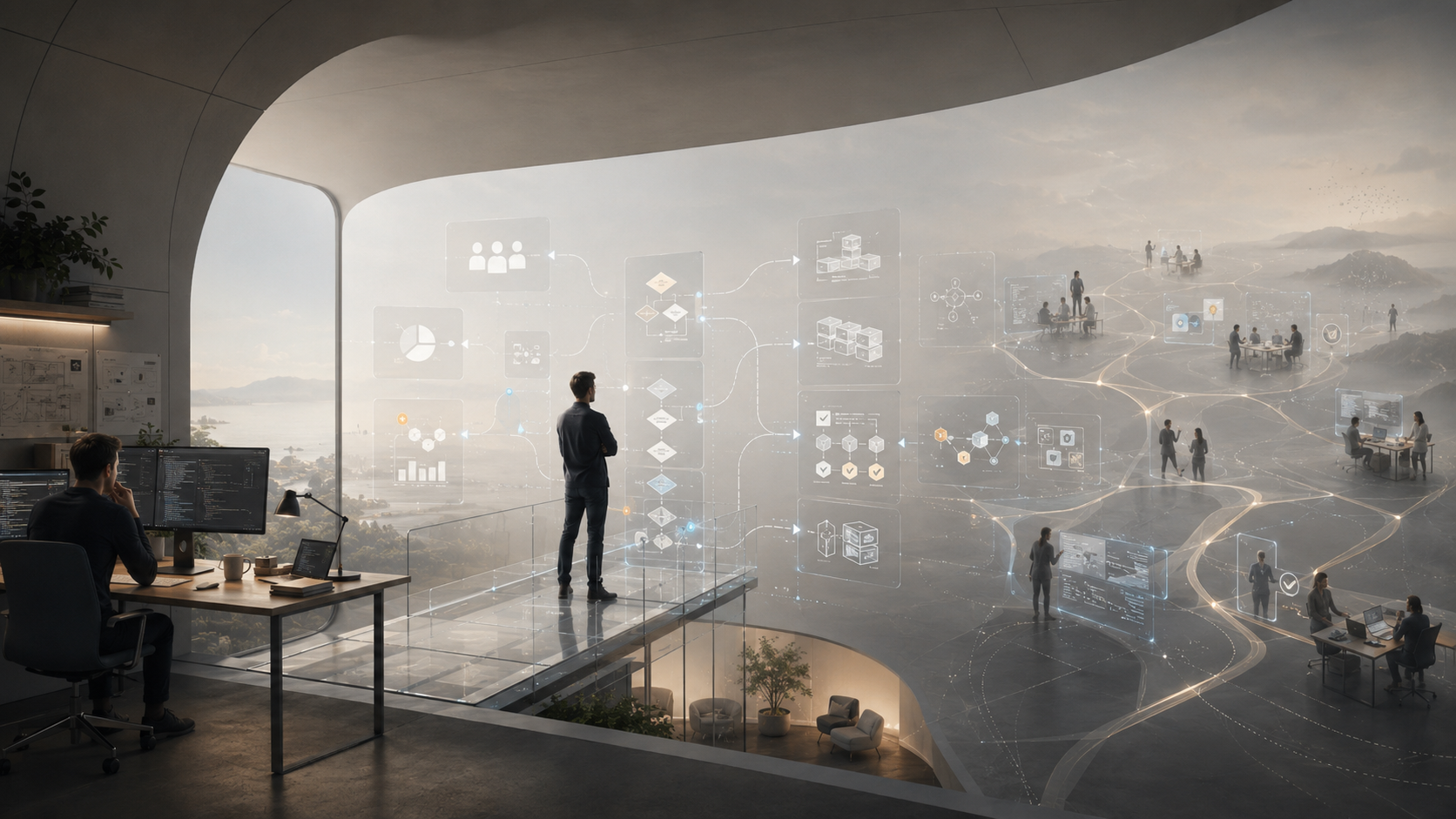
Many people call this future role a Product Engineer: someone who combines product thinking, technical understanding, architecture, and AI orchestration.
That description feels accurate today. I already recognize much of my own work in it. But it raises another question: What if Product Engineer is only a transition?
Let's look five years ahead. AI systems will almost certainly become dramatically better at:
- understanding business context
- reading entire codebases
- learning product history
- evaluating trade-offs
- proposing architectures
- reviewing implementations
- generating specifications themselves
If that happens, why would humans still write detailed specifications? Maybe specifications will become generated artifacts and humans will only define goals. Or maybe they won't even do that.
Capabilities move fast, but adoption doesn't
We are watching two very different timelines.
AI capabilities are improving at an astonishing pace. Every few months, new models appear, new workflows become possible, and tasks that seemed impossible suddenly become routine.
Real transformation inside companies is much slower. Organizations don't change simply because a new model exists. They need to rethink processes, integrate tools, establish governance, train people, build trust, and, perhaps most importantly, prove that AI creates measurable business value.
So far, the economic impact of AI has been much harder to observe than many people expected a few years ago. History suggests that this isn't unusual. The internet, cloud computing, and smartphones all developed technologically long before they fundamentally changed how companies operated. AI may follow the same pattern.
The technology can move incredibly fast while adoption, organizational change, and measurable business impact take many years. That makes timelines surprisingly difficult to predict. The direction may be obvious. The speed almost certainly isn't.
The bottleneck always moves

History shows something interesting. Technology rarely removes the bottleneck. It moves it.
- Memory became cheap.
- Compute became cheap.
- Storage became cheap.
- Writing code is becoming cheap.
So what becomes expensive next? It might be good product decisions, prioritization, trust, accountability, strategy, human relationships, or understanding real customer problems. Or it might be something we haven't identified yet.
But even these activities are increasingly supported by AI. I already discuss difficult decisions with LLMs. They challenge assumptions, generate alternatives, and help me structure arguments. Sometimes they even find better solutions than the ones I had initially.
If AI becomes excellent at strategic reasoning as well, what remains uniquely human?
I don't know, and I don't think anyone honestly does.
What does this mean for companies?

If one person plus AI can build what previously required a team of twenty, what happens to organizations?
Companies might become much smaller. Instead of hundreds of engineers, they could consist of:
- one CEO
- one product leader
- one sales leader
- one finance lead
supported by autonomous agents.
But large companies might not disappear. They could instead become collections of tiny, autonomous teams, more like an ecosystem of startups under one umbrella.
Both futures seem plausible.
We've seen difficult transitions before
People often compare AI to the Industrial Revolution. There are similarities: productivity increased dramatically, new industries emerged, and living standards eventually improved.
But one important detail is often forgotten: the transition wasn't smooth. Many professions disappeared long before new ones appeared, and entire generations experienced painful economic disruption.
Could AI create a similar transition for knowledge work? Possibly. Maybe even a faster one.
The hardest question isn't technical
The hardest question isn't:
Can AI build software?
I'm already convinced that the answer is yes. The harder question is:
What role will humans still play once AI can participate in nearly every cognitive task involved in software development?
Maybe Product Engineer is the answer. Maybe it's only another temporary step. Or maybe the future looks completely different from anything we're imagining today.
My current conclusion
A year ago, I probably would have tried to predict the future. Today, I'm much more cautious. The speed of AI development makes long-term predictions incredibly difficult.
Ironically, technological progress and real-world adoption may move at very different speeds. What feels technically inevitable today may still take years to fundamentally reshape organizations and economies.
That is why I think these discussions matter. Not because we can predict the future, but because they help us recognize which assumptions from today's world we carry into tomorrow's. Those assumptions might be our biggest blind spot.