AI adoption is accelerating. Organizations aren't changing with it.


Two years ago, the main question about AI in software engineering was whether large language models could generate useful code. That question already feels outdated.
Most large organizations now use AI somewhere in their daily work. Developers use coding assistants, product managers experiment with AI-generated documents, marketing teams create content with LLMs, and customer support teams deploy chatbots. AI adoption is no longer the exception.
But the organizations around these tools have barely changed. Companies are adopting AI without reinventing themselves around it.
The AI productivity paradox
AI capabilities continue to improve quickly, but measurable business results have been harder to find than many expected a few years ago.
McKinsey's State of Organizations 2026 describes this gap. While 88% of organizations are experimenting with AI, 81% report no meaningful bottom-line gains so far. According to the report, access to AI is no longer the main problem. Organizations struggle to redesign how work is actually done.
The same pattern appears across recent industry research: organizations are getting better at deploying AI tools, but they are much less successful at changing the organization around them.
AI changes tasks, not operating models
Most AI initiatives improve an existing activity. Developers write code faster. Support agents answer tickets faster. Analysts summarize documents faster. Employees become more productive, but the process around them remains largely untouched.
The approval chains, management layers, responsibilities, team structures, and workflows stay the same.
McKinsey recently described this as one of the biggest barriers to capturing AI's economic value. Its conclusion is simple:
Most companies are accelerating existing work instead of redesigning how work gets done.
Organizations that see significant financial results from AI are much more likely to redesign their workflows and operating models before they choose the tools.
Technology may no longer be the bottleneck
Enterprise AI discussions focused on model quality for years. Are the models good enough? Can they reason, write code, and understand complex business problems?
Those questions still matter, but they no longer seem to be the main constraint. The bottleneck increasingly looks organizational rather than technical.
McKinsey's Superagency in the Workplace reaches a similar conclusion. Its research suggests that employees are generally ready to use AI, while leadership and organizational change are holding them back.
Are we optimizing the wrong thing?
Perhaps we are asking the wrong question. Instead of asking:
"How can AI improve our current way of working?"
we could ask:
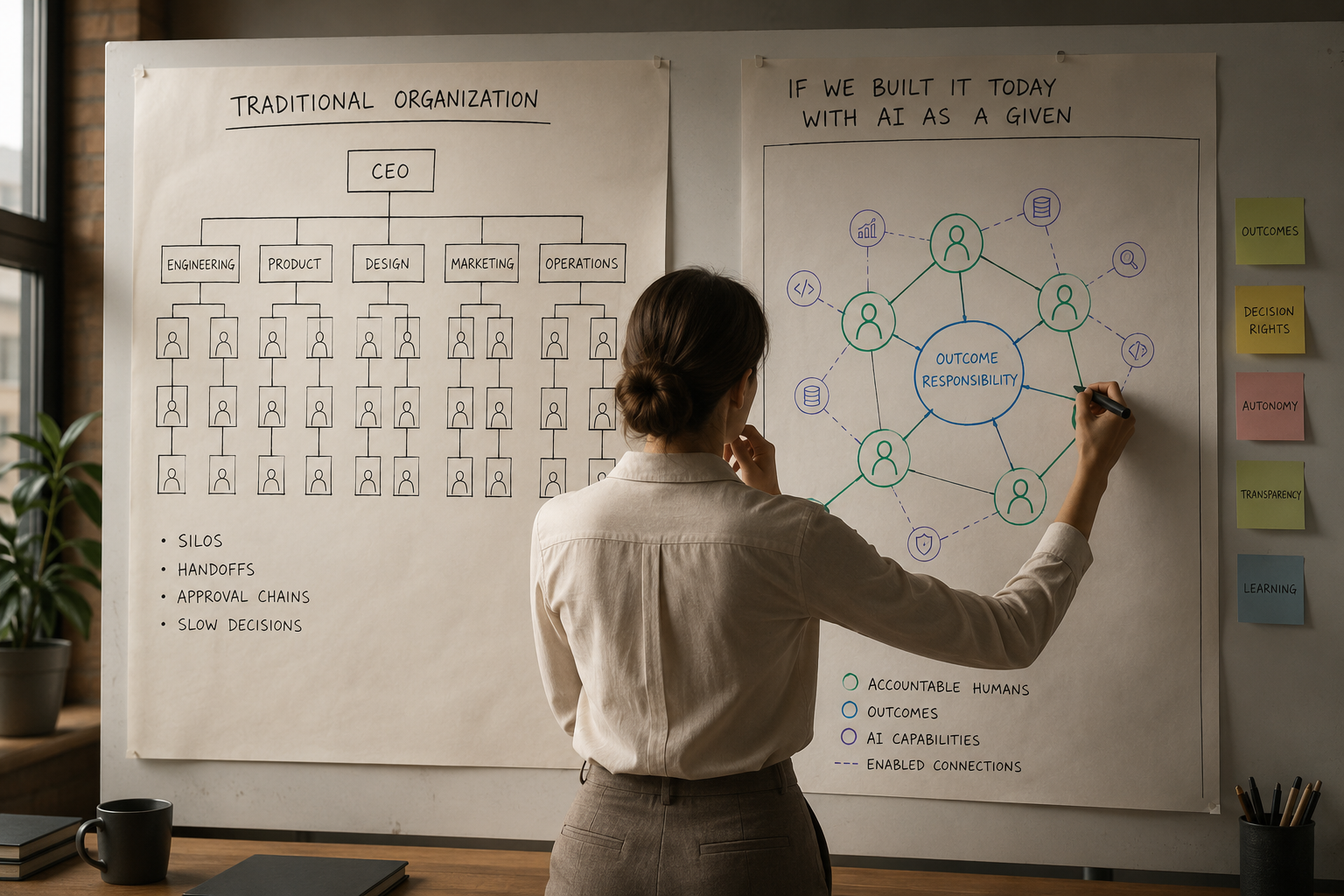
"If we built this company from scratch today with AI as a given, would it even look like today's organization?"
This moves the discussion away from prompts, copilots, and coding assistants. It becomes a question about organizational design.
Start with a new company
It is hard to discuss organizational transformation without starting from today's reporting lines, departments, processes, and management structures. But that may be the wrong starting point.
Imagine founding a software company in 2026. Powerful AI models are available from day one. There are no legacy processes, established departments, reporting lines, or organizational chart to preserve.
Would you rebuild the company structures we know today? Would you create separate departments for engineering, product management, quality assurance, UX, data, SEO, marketing, and operations? Would work still pass from one specialist team to the next through tickets, meetings, documents, and approvals?
Probably not.
Specialization would not become irrelevant. Deep expertise would still matter. But AI may change the cost of accessing and applying that expertise.
Companies have historically organized themselves around scarce human capabilities. When they needed software engineering, design, security, legal knowledge, or marketing expertise, they needed dedicated people or teams. AI makes more of this expertise available on demand. As those capabilities become cheaper to access, the structures built around them may change too.
From functions to responsibilities
An AI-native company might organize less around functions and more around responsibilities. Instead of departments such as:
- Engineering
- Product
- Design
- QA
- SEO
- Data
it could organize around areas such as:
- Customer acquisition
- Onboarding
- Search
- Checkout
- Billing
- Retention
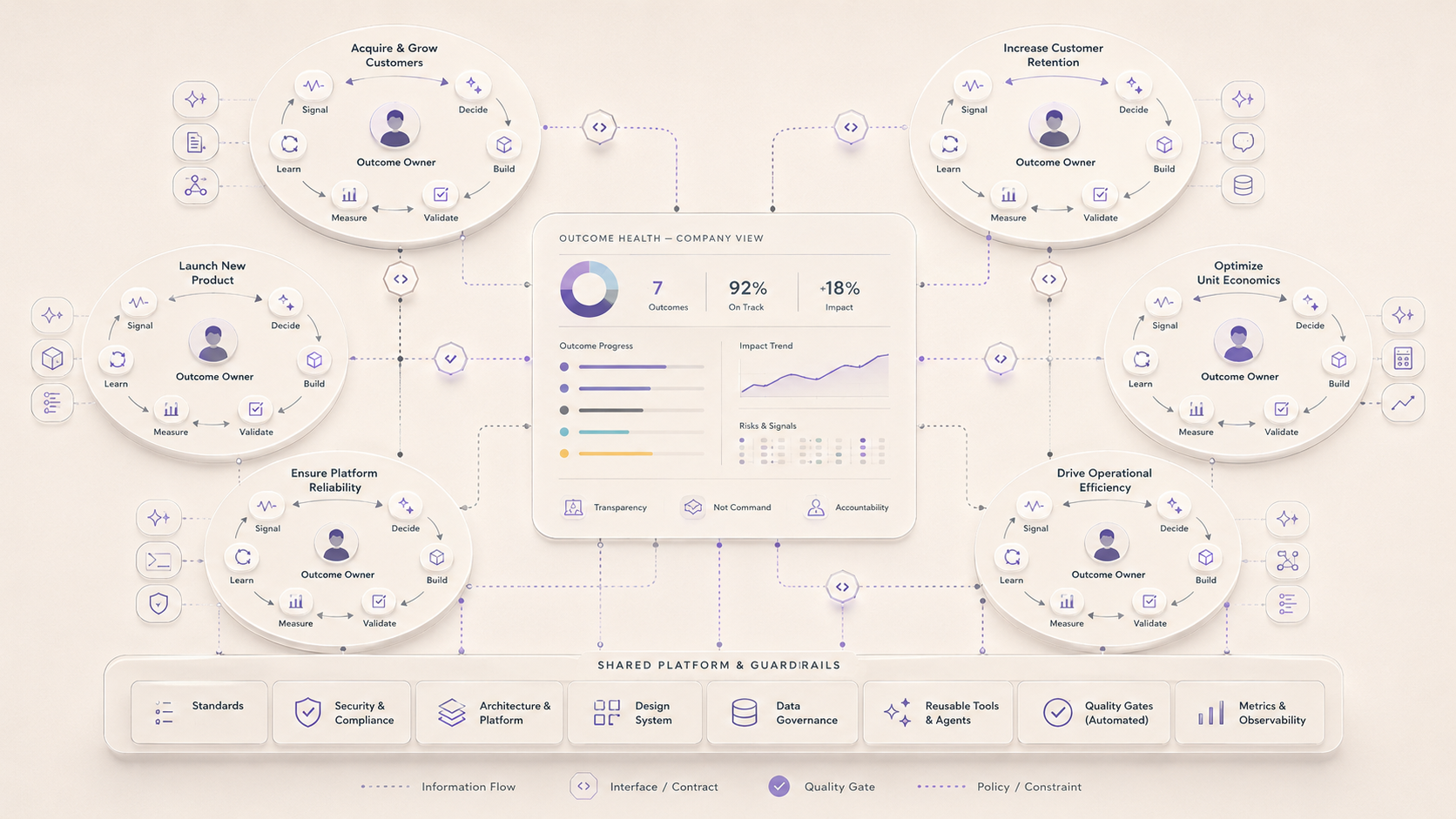
Each area would have a clear outcome and one person, or a very small group, responsible for it from start to finish.
This person would not be a Product Owner who mainly writes tickets for an engineering team. They would act more like a small CEO for their area: understand the customer problem, set priorities, make trade-offs, evaluate the results, and remain accountable for the outcome.
AI agents could help with implementation, analysis, testing, research, documentation, design exploration, security reviews, performance optimization, and operations. The smallest organizational unit might no longer be a team of specialists. It could be:
One accountable human, supported by a system of specialized agents.
Product Engineer may be a transitional role
The emerging Product Engineer role already points in this direction. It combines technical implementation with product thinking, customer understanding, and broader ownership. The role moves away from narrow execution and toward end-to-end responsibility.
But Product Engineer may still be transitional. The word Engineer keeps implementation at the center of the role.
In a more advanced AI-native organization, implementation may be only a small part of the job. The human might spend little time personally writing code, creating mockups, analyzing data, or producing specifications. Their main job would be to understand the area, make decisions, set constraints, judge results, and accept responsibility for what happens.
The important shift is not from Developer to Product Engineer. It is from functional contributor to accountable owner. The name matters less than the organizational principle.
Fewer handovers may matter more than fewer employees
Smaller teams may be the most visible result of AI-native organizations. The more important change could be fewer handovers.
Today, work often passes through a long chain. A business stakeholder identifies a problem. A product manager turns it into a roadmap item. A designer creates a solution, an engineer implements it, a QA specialist tests it, a data analyst measures it, and a marketing or SEO team promotes it.
Every handover adds delay, loses context, requires coordination, and creates another chance for misunderstanding. These handovers exist partly because one person cannot hold all the required expertise, context, and capacity to execute.
AI may weaken that constraint. If one accountable person can use technical, analytical, design, operational, and marketing capabilities through AI, more work can stay within one responsibility area.
The benefit would not simply be that fewer people can do the same work. The organization might need less machinery to coordinate that work in the first place.
Expertise would still matter
This model has an obvious risk: someone responsible for everything may not be deeply qualified in anything.
AI can provide access to expertise, but it does not guarantee good judgment. A generalist supported by agents can still miss subtle security risks, legal consequences, architectural problems, or inconsistencies across the company.
AI-native companies would probably not remove specialized functions completely. Instead, security, architecture, design, legal, data, and platform experts could work as small competence centers rather than large execution departments.
They could:
- define company-wide standards
- establish constraints and quality gates
- maintain reusable tools and agents
- preserve institutional knowledge
- advise responsibility owners
- review high-risk decisions
- intervene when problems exceed the capabilities of an area
Responsibility would remain close to the product area, while deep expertise would remain available across the organization. This separates two roles that companies often combine today:
Who owns the outcome, and who holds the deepest expertise?
They do not always need to be the same person.
Management would change too
Traditional management includes distributing information, coordinating work across teams, tracking progress, escalating decisions, and translating priorities between organizational layers. AI could automate or simplify parts of this work.
Context could be documented continuously. Systems could identify dependencies, evaluate progress against explicit outcomes, and keep decisions and their reasoning accessible across the company.
This does not make management unnecessary. Leadership is more than distributing information. People still need coaching, conflict resolution, judgment, motivation, hiring, feedback, and difficult personnel decisions.
But the value of management could shift. Managers who mainly act as information brokers may become less necessary. Managers who give direction, develop people, resolve ambiguity, and accept responsibility may become more important.
AI-native companies may have fewer management layers and expect much more actual leadership from the managers who remain.
Several models could work
There probably is no single blueprint for an AI-native company. Different organizations may combine several models.
The outcome-oriented company
The organization is built around customer or business outcomes instead of traditional departments. Each area has a clear owner and access to agents and shared capabilities.
The agent-first company
Every employee works with a personal team of agents. The formal organizational chart may look familiar, but the real unit of production is an employee plus a collection of AI systems that handle specialized work.
The platform company
Traditional functions become small internal platform teams. They maintain standards, infrastructure, reusable agents, policies, and guardrails so autonomous product areas can operate safely. They act less like centralized service departments and more like maintainers of an internal ecosystem.
The company of micro-companies
A larger organization could become a collection of small, autonomous business or product units. Each unit may consist of only a few people supported by agents.
The central organization provides capital, brand, legal infrastructure, shared technology, and strategic direction. Individual units operate almost like startups.
These models are not mutually exclusive. A company could organize around outcomes, give every employee an agent team, use centralized competence platforms, and split a large portfolio into autonomous micro-companies at the same time.
The organizational chart may be the wrong abstraction
Traditional organizational charts answer one main question:
Who reports to whom?
That question will remain relevant. Companies still need legal accountability, compensation structures, leadership, and personnel management. But reporting lines may become less useful for understanding how work gets done.
A better representation of an AI-native company might show:
- who owns each outcome
- which decisions they can make
- which constraints they must respect
- which agents and platforms they can use
- which experts support them
- how success is measured
- where accountability ultimately sits
The company could look less like a hierarchy of functions and more like a network of responsibilities.
The trade-offs are real
This model would not be painless. More autonomy also creates more cognitive load. Not everyone wants to act like the CEO of a product area, make decisions with limited oversight, or accept broad responsibility for the results.
Autonomous areas could create inconsistent customer experiences, duplicate systems, make incompatible technical decisions, or apply standards unevenly. A person supported by AI can move quickly and still move in the wrong direction.
So autonomy cannot mean a lack of constraints. An AI-native company would likely need stronger shared principles, clearer interfaces, better automated quality controls, and more explicit responsibilities than many organizations have today.
Less coordination through hierarchy may require more coordination through systems.
A company designed around accountability
The main idea is not that an AI-native company has no departments, no managers, and almost no employees. That is one possible outcome, but it is too simple.
The more interesting possibility is that AI changes the basic unit around which the company is organized. Traditional companies organize people by function because expertise and execution capacity are scarce. AI-native companies may organize capabilities around accountable outcomes because expertise and execution are more widely available.
The question would no longer be:
Which department should perform this task?
It would become:
Who is responsible for this outcome, and what human and AI capabilities do they need to achieve it?
That sounds like a small change, but it may be a radical one.
Perhaps an AI-native company will not be defined simply by using AI everywhere. It may be defined by organizing around outcomes and assembling humans and AI around them as needed.
What do you think? Is this a future you can imagine, or do you forecast another scenario?